
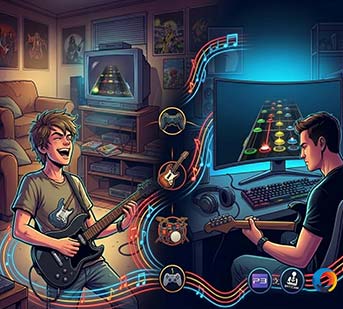
The Guitar Hero Story: From PS2 Living Rooms to Clone Hero and Emulation
A Complete History of Guitar Hero Culture
Origins: From Japanese Arcades to the Living Room
The story of Guitar Hero doesn’t begin in 2005. The basic concept was directly inspired by GuitarFreaks, a 1998 Konami arcade game popular in Japan that used a guitar-shaped controller with gameplay essentially the same as this one. RedOctane, who designed the GuitarFreaks peripheral, had such an affinity for rhythm gaming that they wanted to build a series of their own — this time for the home console market.
Joining them was Boston-based developer Harmonix Music Systems, a studio built from the ground up by musicians. The people making the game were ingrained in the culture they were trying to imitate — developers who’d been on the road in their own bands, slept in vans, had shitty practice spaces and guitars of their own. That authenticity shaped everything about what Guitar Hero would become.
The Huang brothers at RedOctane raised $1.75 million for the effort, despite being turned down by investors who thought the idea was too weird. Major publishers passed. Acclaim, for instance, believed the necessity of a unique peripheral would make it a hard sell for general audiences. They were spectacularly wrong.
The Launch: PlayStation 2, 2005
Released for the PlayStation 2, the original Guitar Hero featured 30 songs with 17 additional unlockable tracks. With a budget of roughly $1 million, RedOctane and Harmonix relied primarily on covers of rock songs spanning five decades, from the 1960s through to 2005.
Shortly after release, it became an unexpected hit — the second-highest-selling PlayStation 2 title in February 2006. Game sales reached $45 million in 2005 alone.
The controller itself — a miniature replica of a Gibson SG — was the product’s killer feature. Five coloured fret buttons. A strum bar. A whammy bar. Simple enough to understand in seconds, difficult enough to master over the years.
The Expansion: Every Console Wanted In
Guitar Hero II arrived in 2006 and pushed the franchise into genuine phenomenon territory. It featured 40 tracks on PS2 and 48 on Xbox 360, with covers from bands like Avenged Sevenfold, Deep Purple, Rush, and Alice in Chains alongside master tracks from bands like My Chemical Romance. The Xbox 360 version also introduced downloadable content — a relatively new concept for consoles at the time.
Guitar Hero III: Legends of Rock (2007) — the franchise’s cultural peak. Boss battles pitted players against legendary guitarists in musical showdowns, online multiplayer arrived for the first time, and the bundled wireless Guitar Hero controller – A Les Paul look-alike changed how the game felt to play. No cables. No tripping over the lounge room floor. For many players, this was the definitive Guitar Hero experience. By this point, the franchise had spread across every major platform of the era:
PlayStation 2 — where it all began; the PS2 version remained relevant well into the series’ peak.
Xbox 360 — the version that cracked the mainstream and introduced DLC.
PlayStation 3 — the high-definition era, and the platform most commonly emulated today via RPCS3.
Nintendo Wii — motion controls made tilt-to-activate Star Power feel genuinely physical.
Nintendo DS — the handheld version included a peripheral called the “Guitar Grip” that fitted into the DS’s second slot, with the first four fret buttons and a guitar pick-shaped stylus used for strumming on the touchscreen.
The Peak: Guitar Hero III and a Cultural Moment
By 2007, Guitar Hero III had crossed from video game into cultural event. An episode of South Park was written in direct response to the game’s popularity. Guinness World Records recognised the highest-scoring players. Guitar Hero appeared in a Mariah Carey music video. Ellen DeGeneres had a teenage Guitar Hero expert on her talk show to play DragonForce in front of a live studio audience.
The series sold more than 25 million units worldwide and earned over $2 billion at retail.
The Song That Defined a Generation
No single track captures the Guitar Hero era more completely than DragonForce’s “Through the Fire and Flames.” An eight-minute power metal sprint with twin guitar solos at inhuman speed, it was the final unlockable song in Guitar Hero III — a reward reserved for players who had already conquered everything else.
DragonForce saw a 126% increase in CD sales in the week after Guitar Hero III’s release. Downloads of the song, previously selling fewer than 2,000 copies weekly, rose to over 10,000 after the game launched and approached 40,000 by the end of December 2007.
Herman Li recalls the record label calling to report that they were selling albums at an unprecedented rate, and that the next tour saw them elevated to playing just before headliners Slipknot and Disturbed at the Mayhem festival. The financial reality behind the song’s placement was starkly different. Li later revealed that the band received a one-off fee of around $3,000 for “Through the Fire and Flames” — a sum then divided among the band members, their manager, record label, and accountants. The exposure, however, was incalculable. The song has sold over 1.1 million copies in the United States alone, is certified platinum by the RIAA, and today sits at over 300 million Spotify plays — a margin far beyond any other DragonForce recording.
Other Defining Tracks
Guitar Hero built its reputation on songs players already knew, presented at difficulty levels that made mastery feel genuinely earned:
“Slow Ride” — Foghat, Guitar Hero II. The gateway song. Set to Easy difficulty, it was how most people first understood that this was something special.
“Sweet Child O’ Mine” — Guns N’ Roses, Guitar Hero II. The opening riff became one of the most practised sequences in gaming history.
“Free Bird” — Lynyrd Skynyrd, Guitar Hero II. A six-minute monument to the southern rock guitar solo.
“Welcome to the Jungle” — Guns N’ Roses, Guitar Hero III. One of the definitive Expert-difficulty encounters.
“One” — Metallica, Guitar Hero: Metallica. The machine-gun bridge section became the community’s benchmark for finger speed.
“Through the Fire and Flames” — DragonForce, Guitar Hero III. The final boss. The rite of passage.
Guitar Hero as Music Discovery Engine
A survey conducted by Brown University found that 76% of Guitar Hero players went on to purchase music they first heard in the game. Every Guitar Hero III song tracked by Nielsen SoundScan saw an increase in digital download sales during the Christmas week of 2007, with individual songs in Guitar Hero III and Rock Band recording sales increases across 2007 ranging from 15% to 843%.
Guitar Hero: Aerosmith made more money for the band than any of their studio albums. The game wasn’t just selling itself — it was functioning as the most effective music promotion vehicle of the 2000s.
The Expanded Universe: Spin-offs and Band Games
As the franchise grew, Activision pushed into territory well beyond the core series.
Guitar Hero: Encore — Rocks the 80s (2007) — a standalone expansion built entirely around the decade that made the guitar solo a commercial product. Cheap Trick, Iron Maiden, Poison, Twisted Sister.
Guitar Hero: Aerosmith (2008) — the first band-specific title, following the group’s career from early club shows to arena rock. Included Aerosmith’s hits alongside songs from artists who influenced them, with historical footage and interviews woven throughout.
Guitar Hero World Tour (2008) — the full-band expansion. In addition to a new guitar controller, World Tour introduced drum and microphone controllers to allow players to simulate the entire rock and roll experience — a direct response to the rival Rock Band franchise, which Harmonix had developed after separating from the Guitar Hero series. A built-in Music Studio lets players create and share original compositions.
Guitar Hero: Metallica (2009) — arguably the finest band-specific entry. Metallica’s catalogue suited the game format perfectly, and the inclusion of tracks like “Battery,” “Master of Puppets,” and “One” gave the community some of its most replayed Expert charts.
Guitar Hero: Van Halen (2009) — Eddie Van Halen’s guitar work translated directly into some of the most technically demanding fret patterns in the series.
Band Hero (2009) — a pop-focused variant built around the Guitar Hero World Tour engine, with a setlist including Taylor Swift, No Doubt, and Vampire Weekend.
Guitar Hero Arcade (2009) — The franchise made its way into commercial arcades via a collaboration between Raw Thrills, Konami, and Activision. The cabinet was a two-player upright unit built around the Guitar Hero III gameplay — 50 songs, a 32-inch LCD screen, an eight-speaker sound system, and over 400 LEDs pulsing to the music. Instead of the home console’s plastic Les Paul, the arcade version used Enduro-AX Industrial Strength guitar controllers — heavier, built to survive thousands of plays in public locations.
It sold over 2,000 units in its first three months. The setlist drew primarily from Guitar Hero III and Guitar Hero: Aerosmith; operators could enable or disable individual songs, and premium tracks cost an extra credit to play. Online tournament functionality allowed venues to run competitive nights.
The cabinet never got a sequel. By the time it hit arcades in 2009, the home console market was already contracting, and arcade venues were a fraction of their former footprint. Units still surface in retro arcades today — heavy, loud, and immediately recognisable.
Guitar Hero: Warriors of Rock (2010) — the final mainline Neversoft entry, returning the focus to pure rock and guitar shredding after the full-band era. Narrated by Gene Simmons. It posted the worst first-month sales in franchise history.
Guitar Hero Live (2015) — a full reboot developed by FreeStyleGames that dropped the standard five-button controller in favour of a six-button design with two rows of three buttons, more closely mimicking actual guitar fingering. The career mode used full-motion video shot from a first-person stage perspective. The online mode, GHTV, streamed playable songs in a music video channel format. It remains the franchise’s last official entry.
The Rival: Rock Band
Harmonix — Guitar Hero’s original developer — was acquired by MTV Networks in 2006 and immediately set about building a competitor. Rock Band launched in 2007 and expanded the formula to a full four-piece band: guitar, bass, drums, and vocals simultaneously.
Where Guitar Hero leaned into the rock star fantasy of the solo guitarist, Rock Band leaned into the social experience of playing together. The rivalry between the two franchises drove both to their creative peaks. By 2009, households with instrument peripherals stacked in the corner of the lounge room had become a genuine cultural cliché — and a retail headache.
Rock Band’s legacy endures differently. Harmonix continued supporting Rock Band 4 with DLC releases for years after Guitar Hero went quiet, and the Rock Band community maintains an active online catalogue through Harmonix’s servers to this day.
The Collapse: 2009–2011
Activision had flooded the market. Multiple titles per year. Band-specific spin-offs are releasing back-to-back. Peripheral fatigue was real — the guitars, drum kits, and microphones that had once seemed exciting were now piling up as returned stock on retail shelves.
Sales of later Guitar Hero titles dropped, primarily because existing players had already bought the expensive hardware, and not enough new players were adopting the game to sustain its previous momentum. The Kurt Cobain controversy — Guitar Hero 5 allowed players to use Cobain’s avatar to sing any song in the game, which the surviving members of Nirvana publicly condemned — didn’t help the franchise’s standing with older music fans either.
Citing declining revenues, Activision ceased development of Guitar Hero in February 2011. The plastic guitar era was officially over.
The Afterlife: Clone Hero and the Emulation Scene
The official games stopped. The community didn’t.
Clone Hero
Clone Hero is a free, fan-made PC rhythm game created by developer Ryan Foster, released as version 1.0 in November 2022 after over a decade of development. The gameplay is nearly identical to Guitar Hero: coloured notes scroll toward the player, who must hit the corresponding fret buttons and strum bar in time. The controller support covers the full range of original Guitar Hero and Rock Band peripherals, as well as keyboards and any other PC-compatible input device.
The origins go back to around 2012, when the creator — known in the community as srylain — began building a rhythm game he personally wanted to play, initially using Microsoft’s XNA framework before switching to Unity after XNA was discontinued.
The key distinction from official Guitar Hero releases: Clone Hero ships with only a small bundled setlist, but supports an unlimited library of community-made “charts” — note tracks that players create and share for any song they choose. Unlike official Guitar Hero titles, which required licensed music, Clone Hero allows any audio file to be charted. Metal subgenres, video game soundtracks, classical pieces, memes, and deliberately impossible “troll charts” designed to confound experienced players. The community has charted tens of thousands of songs.
Clone Hero made appearances at Awesome Games Done Quick 2020 and Summer Games Done Quick 2023, both times performed by community figure Frif, introducing the game to speedrunning audiences worldwide.
The competitive side revolves around Full Combo (FC) and Perfect Full Combo (PFC) runs — completing a song without a single missed note, and completing it with every note hit at maximum timing accuracy, respectively. These runs are streamed, clipped, and posted. A competitive circuit of tournaments runs year-round via Discord servers and Twitch.
Clone Hero V1.1 has been in active development with a focus on integrated server-validated leaderboards — a scoring system designed from the ground up to prevent cheating, in which players’ game inputs are transmitted to a server that recreates the run independently for verification. A dedicated Clone Hero Launcher has also been released, allowing players to manage multiple game installations, track community events, and discover who is currently livestreaming in the Clone Hero Twitch category.
Emulation: Playing the Originals in 2025
For players who want the original Guitar Hero experience — the licensed songs, the specific feel of the career modes, the authentic presentation — emulation is the path.
RPCS3 is the primary option for PS3-era titles. Guitar Hero World Tour, Guitar Hero: Aerosmith, Guitar Hero: Metallica, Guitar Hero: Van Halen, Guitar Hero: Greatest Hits, and Guitar Hero: Warriors of Rock are all listed as Playable on the official RPCS3 compatibility list. The emulator runs these titles in high definition, often outperforming the original hardware visually.
PCSX2 handles the PS2-era library — the original Guitar Hero, Guitar Hero II, and Guitar Hero Encore: Rocks the 80s.
Dolphin covers the Wii versions, which had distinct setlists and motion control implementations worth preserving.
Getting original PS3 guitars running on RPCS3 comes with caveats. The PS3 Les Paul controllers are known for poor Bluetooth connection stability and latency when used with RPCS3, and tilt functionality is often broken. The community recommendation is to modify the controller into a wired configuration. This is where the hardware modding scene intersects with emulation.
The Modding Scene: Mechanical Switches and Custom Hardware
Players who want to compete at a high level in Clone Hero or emulated Guitar Hero have developed a sophisticated culture around controller modification. The original plastic fret buttons, adequate for casual play, introduce input inconsistency at Expert difficulty. The community solution: install mechanical keyboard switches — the same components used in high-end gaming keyboards — into old guitar shells, producing a sharper, more consistent actuation point.
Strum bars are rebuilt with tighter tolerances. Whammy bars are recalibrated. Every possible source of input lag is eliminated from the chain between fingers and screen. Dedicated builders sell modded guitars and conversion kits, and guides for specific controller models circulate on Reddit, Discord, and YouTube.
A modern clone hero setup optimised for competitive play — a modded guitar with mechanical frets, a 2.4GHz USB dongle receiver, and a low-latency display — performs at a level the original 2005 hardware couldn’t approach.
Guitar Hero Live: Community Resurrection
Guitar Hero Live’s online mode, GHTV, was shut down by Activision in 2018, rendering the streaming side of the game non-functional. The community responded by building GHTV Reloaded — a fan-developed replacement server.
GHTV Reloaded V3 was announced in November 2024, bringing the Guitar Hero Live online mode back to PlayStation 3, PlayStation 4 (including PS5 backwards compatibility), Xbox One (including Xbox Series X/S), and iOS — on unmodified hardware, with cross-play and cross-progression supported across all platforms. It represents an ongoing voluntary development effort to keep an officially dead product functional.
What Guitar Hero Actually Did
The easy summary is that Guitar Hero was a party game that sold 25 million units and then burned out. The fuller picture is more interesting.
Guitar Hero arrived at a moment when mainstream rock had retreated into nu-metal’s seven-string groove riffs and post-grunge restraint. Guitar solos had become culturally unfashionable. The game put them back at the centre of popular culture and aimed them directly at a generation that had grown up after the shred era ended. The generation that grew up playing the game at Expert difficulty subsequently picked up real guitars to reproduce what they’d been doing with plastic ones. Musicians have credited Guitar Hero as a direct pathway into learning real instruments — fingerstyle guitarist Yasmin Williams has spoken about how the game inspired her to develop her one-of-a-kind lap-tapping technique.
The franchise also demonstrated, ahead of its time, that gaming could function as a music industry. It proved that players would pay to access songs they already owned on CD, if the format gave them something a stereo couldn’t — participation. That model prefigured the streaming era’s central argument: access matters as much as ownership.
The community that survived the franchise’s collapse — the Clone Hero tournament players, the RPCS3 emulation builders, the controller modders, the charter community producing thousands of custom songs — is the most complete evidence of what Guitar Hero actually built. It wasn’t a product cycle. It was a culture. And twenty years on from a $1 million PS2 game about a plastic Gibson SG, that culture is still producing new players, new hardware, and new music.
With the right guitar and a loud enough TV, the lounge room is still a stage.