
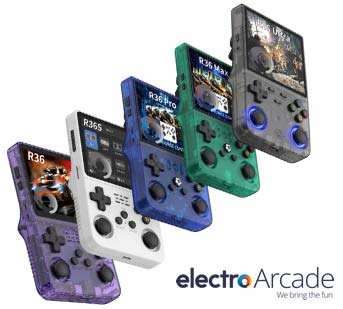
R36 handheld: Game Console Comparison
Electro Arcade · Buyer’s Guide
R36 Series: Models
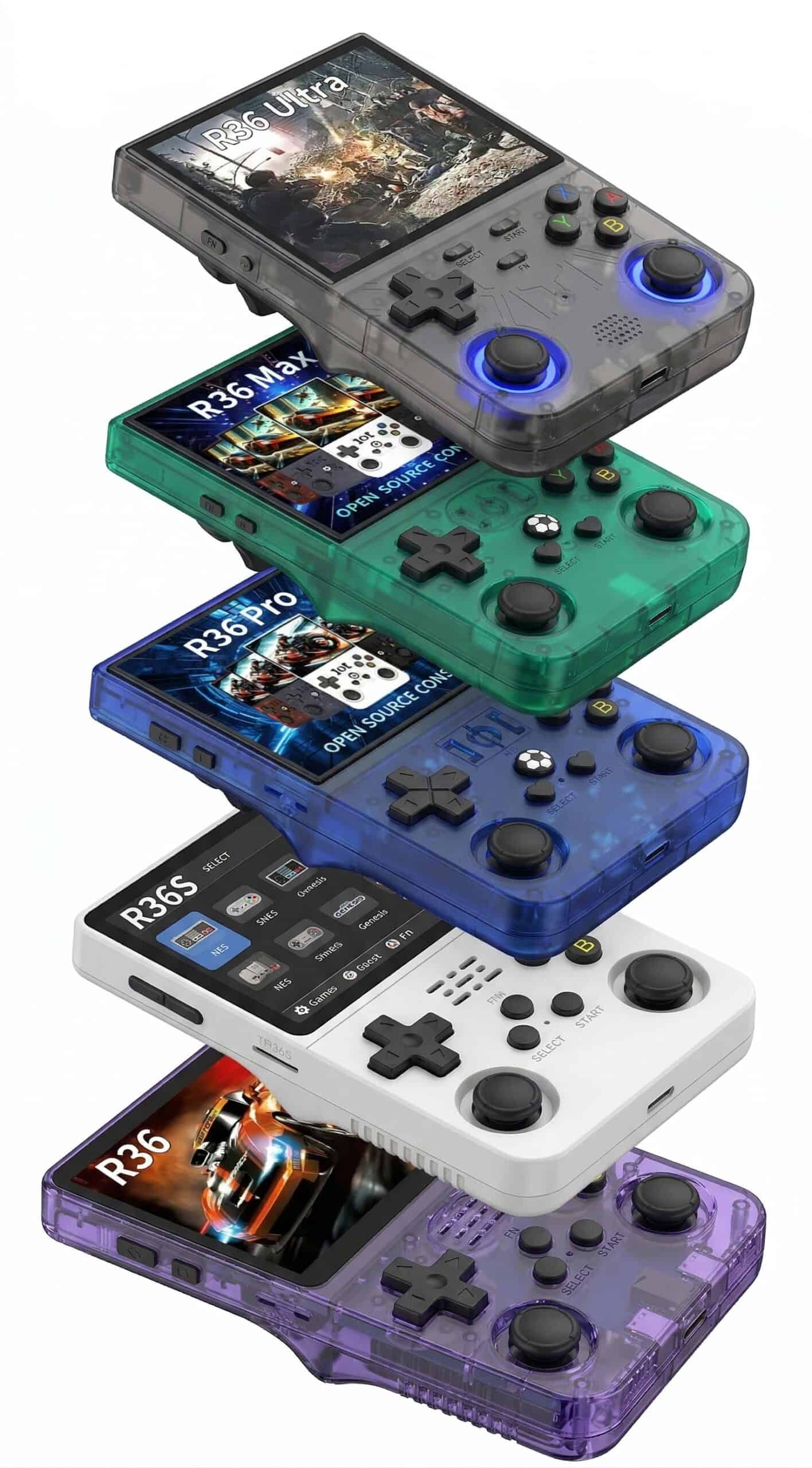
The R36 name now covers five different handhelds – R36, R36S, R36 Pro, R36 Max, and R36 Ultra – and the model names alone don’t tell you which of these retro gaming consoles is worth buying. They share the same RK3326 processor, but differ enough in controls, screen size, Wi-Fi, and storage that the right pick depends entirely on you. This guide breaks down the specs, emulation range, and Australian pricing for all five, model by model, so you can choose the correct R36 handheld console for you.
Quick answer: for most people the R36 Ultra is the R36 to buy — Wi-Fi, a 4″ tempered-glass screen, and 16 GB of built-in storage for the system with one microSD slot for your games, for $99. Get the R36 Pro for drift-free sticks on a 3.5″ screen, or the R36S if price is all that matters. Every model uses the same chip, so they all play the same games.
R36
R36
Original model
Entry-level. No analog sticks — strictly 8-bit and 16-bit gaming. Smallest and lightest of the range.
★★★★★
R36S
R36S
Released Oct 2023
The model that put R36 on the map. Adds dual analog sticks and handles everything up to PS1. Most affordable entry point.
★★★★★
R36 Pro
R36 Pro
Released 2024
R36S with hall-effect sticks that won’t drift over time. Better ergonomics and a bigger battery. Best 3.5″ choice for PS1 and N64.
★★★★★
R36 Max
R36 Max
Released Nov 2024
R36 Pro specs in a larger 4″ body. Right choice if you want the bigger square screen but don’t need Wi-Fi.
★★★★★
R36 Ultra
R36 Ultra
Released 2024–2025
The R36 Ultra is the most feature-complete model. Wi-Fi, split eMMC/TF storage, tempered glass screen, and RetroAchievements support.
★★★★★
Form factor & controls
| Feature | R36 | R36S | R36 Pro | R36 Max | R36 Ultra |
|---|---|---|---|---|---|
| Orientation | Vertical | Vertical | Vertical | Vertical | Vertical |
| Analog sticks | None | Standard dual | Hall-effect dual | Standard dual | 3D dual w/ RGB |
| Clickable sticks | No | Yes | Yes | Yes | Yes |
| Drift risk | N/A | Standard | Drift-free | Standard | Standard |
| Shoulder buttons | Basic | Spring-loaded | Enhanced L/R | Enhanced L/R | Spring-loaded L/R |
| ABXY buttons | Standard | Standard | Tactile, improved rebound | Improved tactile | Mechanical |
Every R36 model runs the same RK3326 chip, so the jump from no sticks (R36) to dual sticks (every other model in the table above) isn’t cosmetic — at this hardware’s performance ceiling, it decides whether entire parts of the library work at all:
- N64 and PS1 camera control. The right stick enables proper N64 C-button mapping — needed for Super Mario 64 or Ocarina of Time — and restores dual-stick control on PS1 titles like Ape Escape and Alien Resurrection. On the base R36, these are unplayable, not just awkward.
- PortMaster and arcade twin-stick ports. RK3326 handhelds lean on PortMaster for native Linux ports — Undertale, Celeste, Half-Life, AM2R — and twin-stick arcade shooters like Smash TV and Robotron need dual analogue input to function at all.
Screen
| Feature | R36 | R36S | R36 Pro | R36 Max | R36 Ultra |
|---|---|---|---|---|---|
| Size | 3.5″ | 3.5″ | 3.5″ | 4″ | 4″ |
| Resolution | ~480p | 640×480 | 640×480 | 720×720 | 720×720 |
| Aspect ratio | 4:3 | 4:3 | 4:3 | 1:1 square | 1:1 square |
| Panel type | IPS | IPS OCA laminated | IPS | IPS | IPS tempered glass |
| Best for | All 4:3 systems | All 4:3 systems | All 4:3 systems | GBA, GBC, NeoGeo Pocket | GBA, GBC, NeoGeo Pocket |
Battery & charging
| Feature | R36 | R36S | R36 Pro | R36 Max | R36 Ultra |
|---|---|---|---|---|---|
| Capacity | ~2500 mAh | 3000–3200 mAh | 4000 mAh | 4000 mAh | 3000 mAh |
| Rated life | 4–5 hrs | 3–4 hrs | ~6 hrs | 6–8 hrs | ~6 hrs |
| Charging | USB-C | USB-C | USB-C | USB-C | USB-C fast (1–2 hrs) |
Connectivity
| Feature | R36 | R36S | R36 Pro | R36 Max | R36 Ultra |
|---|---|---|---|---|---|
| Wi-Fi | No | No | No | No | 2.4 GHz |
| Bluetooth | No | No | No | No | No |
| USB-C data | Charge only | Yes | Yes | Yes | Yes |
| RetroAchievements | No | No | No | No | Yes (via Wi-Fi) |
| OTA updates | No | No | No | No | Yes (via Wi-Fi) |
| Wireless file transfer | No | No | No | No | Yes (via Wi-Fi) |
Storage
| Feature | R36 | R36S | R36 Pro | R36 Max | R36 Ultra |
|---|---|---|---|---|---|
| Internal storage | None | None | None | None | 16 GB eMMC (OS) |
| Card slot | MicroSD | MicroSD | TF (up to 256 GB) | TF (up to 256 GB) | Independent TF (games only) |
| Ships with | — | 64 GB | 64 GB | 64–128 GB | 64–128 GB |
| Split OS/game storage | No | No | No | No | Yes |
Audio
| Feature | R36 | R36S | R36 Pro | R36 Max | R36 Ultra |
|---|---|---|---|---|---|
| Speakers | Mono | Single | Dual stereo | Dual, down-firing | Single (centre) |
| Headphone jack | 3.5 mm | 3.5 mm | 3.5 mm | 3.5 mm | 3.5 mm |
Operating system & firmware
| Feature | R36 | R36S | R36 Pro | R36 Max | R36 Ultra |
|---|---|---|---|---|---|
| Default OS | EmuELEC | EmuELEC | EmuELEC | EmuELEC or ArkOS | EmuELEC |
| Custom firmware | ArkOS, AmberELEC | ArkOS, AmberELEC, ROCKNIX | EmuELEC, ROCKNIX | EmuELEC, ROCKNIX | EmuELEC, ROCKNIX |
| Panel variants | — | 6+ variants — verify before flashing | — | — | — |
Emulation range
| System | R36 | R36S | R36 Pro | R36 Max | R36 Ultra |
|---|---|---|---|---|---|
| 8/16-bit (NES, SNES, Mega Drive, GBA) | Excellent | Excellent | Excellent | Excellent | Excellent |
| PlayStation 1 | Impractical — no sticks | Good | Good | Good | Good |
| Nintendo 64 | Impractical | Hit and miss | Hit and miss | Hit and miss | Hit and miss |
| Dreamcast | No | Light titles only | Light titles only | Light titles only | Light titles only |
| PSP | No | Hit and miss | Hit and miss | Hit and miss | Hit and miss |
| Sega Saturn | No | Non-functional | Non-functional | Non-functional | Non-functional |
The table above is the RK3326’s real ceiling — solid PS1, hit-and-miss N64, light Dreamcast and PSP titles only. Within that ceiling, the second stick keeps paying off well past the games themselves:
- Quick-menu access without a modifier hold. Single-stick devices need a Select+Start-style combo to reach the RetroArch quick menu for save states or exit. With a second stick, L3/R3 clicks toggle it directly — no two-hand fumble mid-game.
- EmuELEC, ArkOS, and ROCKNIX hotkey shortcuts. Custom firmware maps the right stick to volume, brightness, and fast-forward without opening a menu overlay at all.
- A backup once the D-pad wears. The D-pad is usually the first part to fail under heavy 2D use — fighting games, diagonal-heavy platformers. A mapped, deadzone-tuned left stick gives you a fallback once it starts double-inputting or drifting.
Clone device warning
The R36 name is open-source hardware. Devices bearing the R36 name but running the Allwinner F1C200S chip — including the R36S Plus, R36HD, GA36, and PS202 — have no custom firmware support and significantly weaker performance. The R36S Plus is the most commonly encountered: poor D-pad, weak software, wrong chip. Avoid these variants.
Australian price guide
Prices across the R36 range vary by model and retailer, and can shift frequently on platforms like AliExpress and Amazon AU. As a general guide, expect to pay anywhere from around $60 for the base R36 up to $99 for the R36 Ultra. The R36S typically sits around $69–79, with the Pro and Max falling in between, depending on the seller and shipping method. Dual analogue sticks and a 128GB card at $99 is rare — that combination typically starts closer to $150 elsewhere. The R36 Ultra handheld console is available locally through Electro Arcade with fast Australian shipping and a warranty.
Which model should you choose?
R36
Choose the R36 if you want the smallest, lightest device possible and your gaming library stops at 16-bit. If SNES, Mega Drive, and GBA are all you need, the R36 delivers them in a genuinely pocketable form. The moment you want PS1 or anything requiring analog input, this model runs out of road.
R36S
Choose the R36S if budget is your primary consideration. It is the most affordable model with dual analog sticks, handles everything up to PS1 reliably, and has the broadest custom firmware support of the range. It is also the right choice if you want to experiment with ROCKNIX or ArkOS — the community knowledge base around this specific model is larger than any other R36 variant.
R36 Pro
Choose the R36 Pro if you plan to play PS1, N64, or anything that demands sustained analog stick use. Hall-effect sticks are the defining upgrade — they eliminate drift by design, which matters when standard sticks on devices like the R36S begin to wander after heavy use. The larger battery and improved ergonomics are meaningful bonuses. If you want a 3.5″ screen and intend to keep the device for years, the Pro is the smarter long-term buy over the R36S.
R36 Max
Choose the R36 Max if you want a larger, sharper screen but have no need for Wi-Fi. The 4″ 720×720 square panel is a genuine visual upgrade, particularly for GBA, GBC, and Neo Geo Pocket titles that fill the screen natively without stretching. It carries the same battery and control quality as the R36 Pro. If you are choosing between the Max and the Ultra and Wi-Fi is not important to you, the Max is the practical choice.
R36 Ultra
Choose the R36 Ultra if you want the most complete package in the range. The 2.4 GHz Wi-Fi is the feature that sets it apart — it enables RetroAchievements tracking, wireless ROM transfers, and optional firmware downloads without touching a card reader. The split eMMC/TF storage keeps the OS isolated from your game library, which simplifies card management and improves stability. The tempered glass 4″ screen rounds out a device that punches well above its price point. Build quality won’t match Anbernic’s higher-tier aluminium shells, but at this price that isn’t the trade-off you’re paying for.
The R36 Ultra is a solid entry point, but if you’re ready to level up, Electro Arcade has you covered. From Anbernic to Trimui and Mangmi, we stock a range of powerful retro handhelds to suit every player and budget. Browse our Anbernic handheld consoles or explore our full range of Retro gaming handhelds shipped from Australia – backed by a local warranty and fast Australian shipping.
R36 FAQs
R36S vs R36 Ultra — which is better?
The R36 Ultra is the better buy unless every dollar counts. Both use the same RK3326 chip, so they play the same games — excellent up to PS1, hit-and-miss on N64. The Ultra adds a bigger 4″ 720×720 tempered-glass screen, 2.4 GHz Wi-Fi (RetroAchievements and wireless transfers), built-in storage for the system with one microSD slot for your games. The R36S has a 3.5″ 4:3 screen and the largest custom-firmware community.
R36 Ultra vs R36 Max — what’s the difference?
They share the same chip and the same 4″ 720×720 square screen; the difference is features versus battery. The R36 Ultra adds Wi-Fi, built-in system storage (one microSD slot for games) and a tempered-glass screen. The R36 Max has a larger 4000 mAh battery (about 6–8 hours versus the Ultra’s 6), dual down-firing speakers, and ships with EmuELEC or ArkOS depending on the seller. If you don’t need Wi-Fi, the Max is the practical pick.
Which R36 handheld is best in 2026?
The R36 Ultra is the best all-rounder: Wi-Fi, a 4″ tempered-glass screen, built-in storage for the system with one microSD slot for games, for $99 from Electro Arcade with a local warranty. Pick the R36 Pro for drift-free hall-effect sticks on a 3.5″ screen, or the R36S if you want the cheapest model with dual analogue sticks.
What are the R36 Ultra’s specs?
The R36 Ultra has an RK3326 quad-core chip, a 4″ 720×720 IPS tempered-glass screen, 2.4 GHz Wi-Fi, 16 GB of built-in storage for the system and one microSD slot for games (64 or 128 GB card included, up to 512 GB), a 3000 mAh battery (about 6 hours) with fast USB-C charging, a single centre speaker and a 3.5 mm headphone jack. It runs EmuELEC.